

Business Ownership Coach | Investor Financing Podcast is focused on helping entrepreneurs lower their monthly debt payments and increase cash flow through smart SBA refinance strategies. Refinancing an SBA 7(a) can unlock better margins, longer amortizations, and creative deal structures that free up capital for growth. Below I explain when a refinance makes sense, how to qualify, lender differences to expect, real-world examples, and the new SBA flexibilities that are changing acquisition financing.

Photo by Giorgio Tomassetti on Unsplash
Why refinance your SBA 7(a) now?
Interest rate dynamics and updated SBA rules have created a unique window for business owners. Many SBA 7(a) loans originated when prime was much lower. Today, prime has moved, but lenders and SBA policy changes now allow refinances that can reduce payments by at least 10 percent — often without the old hurdle of securing a refusal letter from the original lender.
Refinancing can:
- Lower your monthly debt payment through reamortization and better margins.
- Roll eligible short-term debts into a longer-term SBA structure to improve cash flow.
- Enable acquisitions or rollups by making debt service more manageable.
On the Business Ownership Coach | Investor Financing Podcast I emphasize the goal: get you the lowest debt payment possible while preserving reasonable margins so you have capital to grow.
How qualifying for an SBA 7(a) to 7(a) refinance works
Two rule-of-thumb qualifications stand out. First, the debt being refinanced must be eligible under SBA guidelines. Second, you typically need to show at least a 10 percent reduction in monthly debt payment or demonstrate other clear cash-flow benefits (for example, paying off higher-cost short-term debt) resulting from the refinance.
Most SBA 7(a) loans are variable-rate loans tied to Wall Street Journal Prime plus a margin. On a refinance it is now often sufficient to demonstrate improved cash flow rather than secure a refusal letter from your current lender. That change alone has streamlined the process for many owners.
Real-world use cases that actually move the needle

Photo by Vitaly Gariev on Unsplash
Here are practical examples I work through frequently:
- Home services rollup: A business owner five years into a 7(a) with only five years left on amortization rolled short-term rollup debt into a new 10-year SBA refinance. Monthly payments dropped by roughly 30 percent and cash flow improved enough to continue acquisitions.
- Commercial real estate involved: If CRE is part of the deal, switching from a 7(a) to a 504 refi can be advantageous depending on the project and ownership goals.
- Paying off higher-cost debts: Rolling business credit lines and equipment loans into one SBA facility can simplify payments and lower rates.
These outcomes are possible because the refinance combines term extension, margin improvement in some cases, and consolidation of higher-cost debt into SBA-friendly structures.
Understanding lender differences and margins

Photo by Vitaly Gariev on Unsplash
Lenders all follow SBA standard operating procedures, but they apply overlays and appetite differently. One bank might finance 90 percent of a startup’s project cost while another limits that to 70 percent. Margins on SBA 7(a) can range widely; smaller loans typically carry higher margins. Typical refinance margins might sit around WSJ Prime plus 2.75, but some lenders will offer Prime plus 1.25 on refinances or even a fixed five-year at Prime plus 1.
That variance makes market access important. You may face multiple denials before finding the lender that matches your industry, collateral profile, and risk characteristics. Working with someone who knows which banks underwrite which scenarios is often the difference between a no and a yes.
Benefits you can expect after a successful refinance
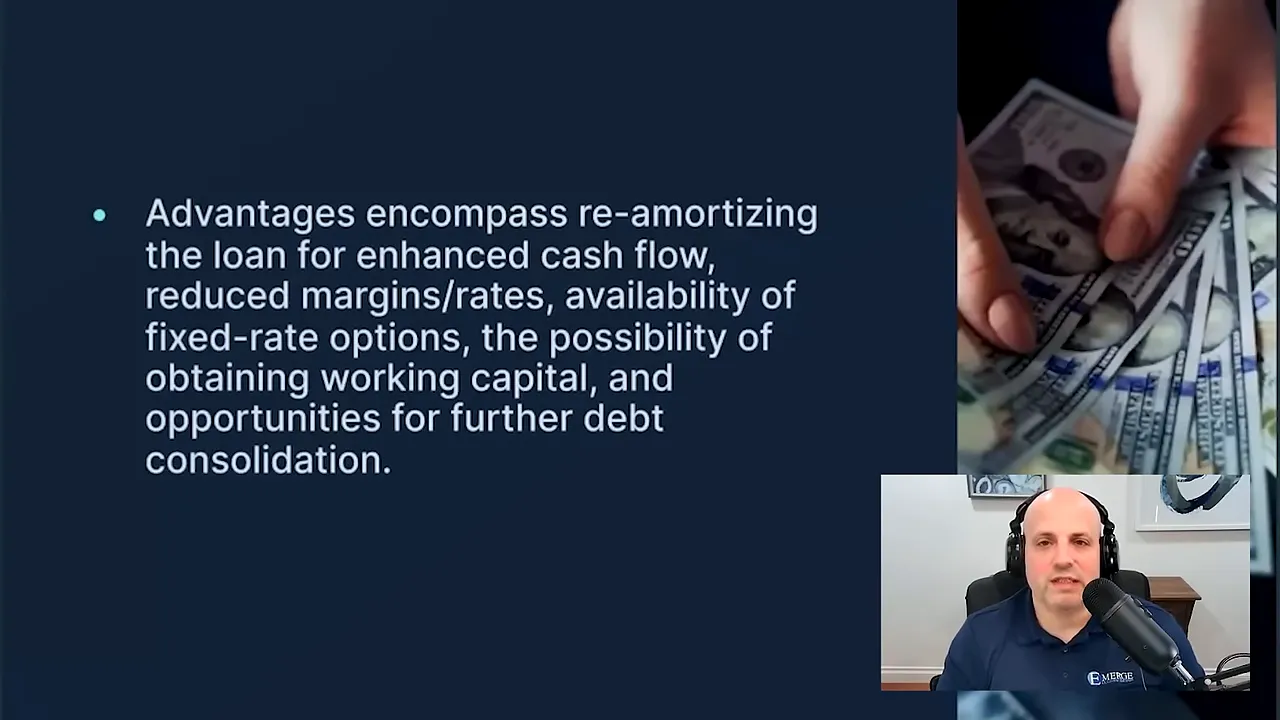
Primary benefits include:
- Extended amortization up to 10 years for loans without real estate, generating immediate monthly savings.
- Opportunity to convert multiple short-term obligations into one predictable, longer-term payment.
- Potential lower variable or fixed margins on the new facility.
- Access to SBA 504 options when CRE is involved to secure even longer amortizations or favorable fixed rates.
When margins and term are aligned, the combined result is increased cash flow — which you can redeploy into growth, acquisition, or working capital.
New SBA flexibilities and creative deal structures
The SBA has rolled out several borrower-friendly changes. Key developments:
- Partial buyouts: You can now structure partial acquisitions where the seller retains a minority stake and, in many cases, is no longer a guarantor if they keep less than 19 percent. That unlocks deals that used to be impossible.
- Aggregate caps and NAICS flexibility: Buying businesses in different NAICS codes can reduce concerns around the $5 million aggregate rule in many situations.
- Seller standby financing: Sellers can carry back a portion of the equity injection. Some lenders accept 5 percent seller standby for two years with no payments required, which reduces borrower cash at close and increases deal creativity.
These changes make complex transactions—rollups, partial buyouts, and multi-industry acquisitions—much more achievable.
How I help and the service model
My role is quarterback. I package the file, match you to the right lender, and help resolve typical underwriting issues as they arise. I don’t charge for most SBA 7(a) or 504 packaging work; I’m typically compensated by the lender. That keeps the barrier to exploring a refinance low for business owners.
What I provide:
- Free initial assessment to see if a refinance or acquisition structure makes sense.
- Packaging and submission to multiple SBA lenders to find the best terms and margins.
- Hand-holding through underwriting and closing to minimize surprises.
Next steps: assessing whether a refinance is right for you

Photo by Vitaly Gariev on Unsplash
Start by calculating your current monthly debt payment and the interest margins on your outstanding loans. Aim for scenarios that produce at least a 10 percent reduction in monthly payment or provide clear net cash-flow improvement after fees and costs.
If you have multiple debts, pending acquisitions, or commercial real estate, consider an evaluation to compare a 7(a) to 7(a) refinance versus 7(a) to 504. Both options can work, depending on project composition.
The Business Ownership Coach | Investor Financing Podcast approach is practical: align amortization, margin, and collateral to maximize monthly cash flow without sacrificing growth capacity.
Ready to explore options? A short discovery conversation can quickly surface whether refinancing will save you money and free capital for growth. If you want help packaging a refinance, rolling debts, or structuring a creative acquisition, reach out and get the right lender working on your terms.
cialis
cialis